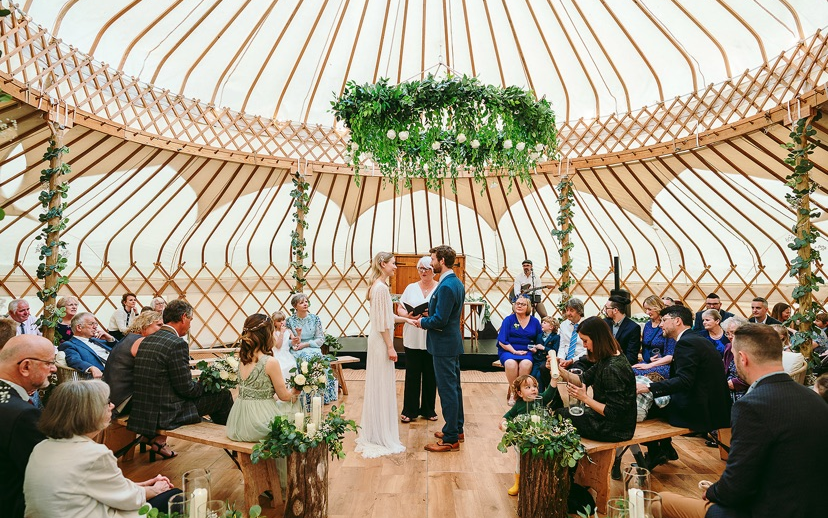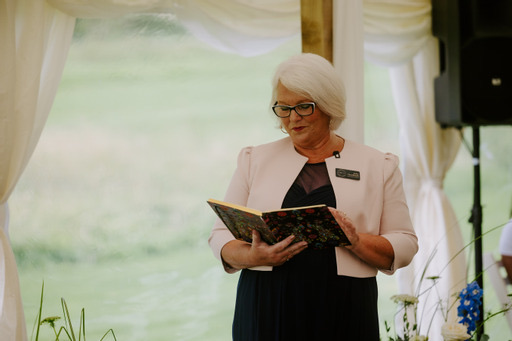
This is the transcript of a conversation broadcast on BBC Radio Devon on 4th September, 2023. It was such a privilege to be able to chat so openly about Celebrancy, the need for a few changes in law, and the reasons behind why I chose this line of work, after so long in education. You can still catch the podcast on BBC catch up, between 10:15 and 11am…
David Fitzgerald
Business as a celebrant has been keeping my next guest very busy this summer and it’s from… well, both ends of the spectrum. Julie Chudleigh helps people at the start of their lives and pays tribute to them at the end. She’s the person who performs or officiates ceremonies and while you might normally most openly see her at weddings, also she does vowel renewals – Sorry, Julie, I keep saying vowel and every time I watch reality television, I say, “There’s a woman that needs a vowel renewal!” – baby namings, funerals, interments and memorials. Listen. First of all, have I got the description of a celebrant correct?
Julie Chudleigh
That’s pretty correct, yes, I often get referred to as a celibate, which is another thing entirely. And not true at all. But anyway, there you go. Yes, the celebrant is somebody who really does celebrate, or commemorate, or mark all the rights of passage in life in a… in a big ceremonial way. It’s a lovely job. I adore it.
David FitzGerald
Fantastic. Could be worse. You could be mistaken for a stick of celery that’s…
Julie Chudleigh
…not likely. We’ve met. You know, I’m much more like a doughnut.
David FitzGerald
And also, I loathe celery. Why was that invented? The disgusting stuff. Well, I’ve got to ask. Has it been busy for you?
Julie Chudleigh
Yes, it’s been very busy. Well, I say it’s been busy. It has been busy on the wedding front because traditionally, summer is wedding season and I’ve been really fortunate because the ceremonies that I’ve done, even if there’s been thunder and lightning the day before, it’s been glorious on the day that the celebration has taken place. Now, I’m not saying I’ve got any connections with any higher power. But… but… it’s just turned out really lucky that the weddings have been so lovely and sunny, so it’s been a joy.
David FitzGerald
A couple of weeks ago it was odd. The heavens opened and I’m talking biblical rain and I happen to know that there was somebody we vaguely knew… their daughter was getting married that day and we all sat down. Ohh no poor things.
Julie Chudleigh
So many of them (because the laws have changed slightly – not enough yet – we may get chance to talk about that in a minute, but the laws have changed slightly in that people can get married anywhere, so they don’t have to be in, you know, a consecrated or registered room in order for the ceremony to take place.) So, a lot of them are planned to be outdoors. You know, you’ve got some wonderful flower filled alleyways that brides can come up through and it’s beautiful. So, if they’ve been planning that and then the rain puts a damper on it and you’re, you’re in a different room… obviously there are always contingency plans in place, but it’s much nicer if that’s their dream, to be wed outside.
David FitzGerald
Do you approve of that? You can get married in a car showroom or on the escalator of Debenhams… is that rather cheapening…?
Julie Chudleigh
I kind of…I kind of do! I tell you what I do approve of. I approve of choice. And I think that, you know, the way I liken it is if you if, when sadly someone passes, a person will go to the registrar of births, deaths and marriages and register that person deceased… with a doctor’s certificate. And then the ceremony for it takes place at some occasion afterwards, and it can be anywhere. So that place can reflect that person’s life. Likewise with a naming when a baby is born, somebody will go to the registrar and officially name the child. And then you can have a naming ceremony, a baptism, a christening, a blessing. You know, whatever your choice is. So, I think the same should actually apply to weddings, that you register a marriage. I mean, we are way behind in the UK. So many other countries actually have celebrants who are the official registrars. They are the ones who are nominated to be able to do so… it’s my own personal preference – because I think it’s a wonderful thing to be married; and I still believe in the sanctity of marriage – so, it’s my own personal preference to marry couples in places that reflect the loveliness of the coming together. But I still think it should offer freedom of choice.
David FitzGerald
Wo, wo, woah! Just… just step back a bit. Do you? Somebody comes to you and right, you’re the celebrant. Do… do you marry people or does there have to be another official in place? I missed that bit when you were talking about going through the registrar bit…are you guided with a… or associated with the registrar? The ceremony?
Julie Chudleigh
Unfortunately, disassociated with the registrars at the ceremony! All celebrants who work in the industry would really love to work with registrars, but it’s become a little bit of an issue. There’s a… there’s a working party that put papers to the government – a white paper to the government last year in July – and there’s lots of work going ahead to try and ensure that celebrants become the people that are actually officially marrying people, but what – in in my case – what I do is, I advise couples to seek the official legal document, which is literally… it can be done in a 15 minute ceremony; they obviously have to go through the official thing where they read the banns and they check that people are of sound mind and that there’s nobody being coerced into this union and that, literally, is a ceremony that needs to be witnessed and can cost £45. I think maximum is fifty… it depends on the county. And so, my preference is to say that couples do that beforehand. So that when I am leading the celebration of that marriage, I’m not allowed to use any of the legal words like, “Do you know of any lawful impediment?” That’s not my responsibility. But I can announce them as a married as a couple. So, there are occasions where couples want the registrar and myself to be present at the same time. Now the law states that we have to clearly make it 2 separate ceremonies. So, we had an issue where one registrar said I wasn’t allowed to be present and I did actually contest that to say, “Look, I’m a friend of the family. I’m a wedding guest, but I won’t, you know, impinge on the legal part of the ceremony until you have signed the document and we have made that clear.” So that’s essentially how it works, but they’re trying to change the laws on that.
David FitzGerald
Good grief! So, if you are married by a celebrant, is this a sweeping statement? It is not technically legal.
Julie Chudleigh
It’s not. No, it’s not. And we thought, you know, most people who are operating wedding venues are requested by the registrars to put up a sign to say that this is not a legal ceremony. But like I say, there is… I mean, it’s very discriminatory … so the laws actually state that you cannot have any religion in a civil ceremony and obviously then the church has got their own (regulation), so there are only certain religious buildings that you can be married in. So first of all, it’s wiping out swathes of people that are not from the Christian religion. You know, it also states that… what happens if a couple are marrying, who say, one is Christian, the other is Hindu. Or one is atheist because it does happen. You know, they say opposites attract, don’t they? And then what? I was asked by a couple – this was just recently, actually, last week, not in Devon. And I won’t mention the name of the place. But I was asked by a couple to read that wonderful Bible reading from Corinthians, you know? It was in Four Weddings and a Funeral, the clanging symbol and the banging drum and love is patient, love is kind. And I was…I was banned from using it, because although the hotel had said that it wasn’t a religious ceremony (nor a civil ceremony) the registrars in that particular county had said that they would remove the venue licence if there was anything religious in the ceremony at all, so it’s quite complex laws (and they are misapplied by registrars and venues!)
David FitzGerald
Well, never knew that. Strangely, this year I have had to attend 2 weddings of the same couple, one in the Muslim faith and one in the Christian faith, because when they got married the first time around in front of an Imam, they said the couple may still not live together until the Christian ceremony has taken place I just thought, “Ah, OK, fine, you know. What’s it called ….?
Julie Chudleigh
Wow, do you happen to know which which one, or either was legal?
David FitzGerald
I would have said both. One was in one was abroad, one was in Amsterdam and one was in this country, and I couldn’t quite understand why the… the…the Muslim faith said that until the Christian ceremony is gone, they may still not live together and. I thought OK. Fine. And it just shows that… that both sides were in agreement; both sides were thinking about the morality, but I just find it very odd. So Julie, I had… I had no idea. And we’ve learned things today that a celebrant was not actually a legal – if that’s the proper term – a legal status to carry out the ceremony in full. That’s the best way of putting it?
Julie Chudleigh
No, not yet. But if you look at Australia, New Zealand, Canada, France, Spain, you know several other overseas countries, we are way behind because in all of those countries, the celebrants are legal. There’s been a big movement from Humanists because they have said, that you know the… the marriage laws which were…. I mean the current laws, originate back to 1750 something, although there have been tweaks – obviously with you know regarding, you know, venues and the… the sexual, the gender of couples etcetera, which has changed things recently – the actual marriage laws are still more than 300 years old. Humanists challenged that a little while ago to say look, this is discriminatory. You know we… we want to actually talk about our beliefs. So, they’re kind of – if you like – doing religion without religion, if that makes sense. So they were the ones to pitch it and the government are considering that. But then I’m an independent celebrant which means particularly in terms of funerals… I… we… people have very strong faiths, but the reality is we don’t actually know what happens. So I think we just need to be really respectful of all faiths, all creeds, none, no creed if necessary. And so as an independent…you know, I have very strong values but will do what the deceased, the bereaved families would like to do. And likewise in weddings and naming services.
David FitzGerald
Right. Am I right in thinking the law changed many, many years ago? You can now get married on a Sunday. Have I imagined this at some point in this wonderful island’s history? You could not get married on a Sunday? Do you know that?
Julie Chudleigh
I…I don’t know. I think that’s not true because my brother and sister-in-law were married on October the 22nd, 1972 in Saint Lukes Church in Torquay (that was a Sunday) So, I’m not sure that that is true.
David FitzGerald
Right. OK. Anyone out there can help? I I sussed that bit of trivia at the back of my mind that at one point you…in this history of ours… you couldn’t get married on a Sunday, but maybe that has changed. I’m just looking online at the moment. The tradition fascinates me. You fascinate me. I had no idea you’re a complete fraud. Isn’t it fascinating? Why is she on here? Julie “the Jackal” Chudleigh will be back with us.
Ed Sheeran Song
David Fitzgerald
I’ve just had a quick scoot around the intima web and all I can find at the moment is that Sunday weddings were not traditionally in place. In olden days, there’s no actual specific date on this. Mainly because the priests would have been very busy anyway on a Sunday with worship, and that’s the only reason I can find it. But I’m pretty sure at one point you could not get married on a Sunday, but obviously that is not the case now.
David FitzGerald
Julie Chudleigh with us today. Thank you for shedding some light on there. Julie. I say this is fascinating. No idea.
Julie Chudleigh
It’s a pleasure to be able to shed some light on it because you know I I feel very strongly about this. We had a conversation the last time I was chatting to you. We were talking about why I think the role of a celebrant is important and I think that, you know, some people have moved away from the church, but there still needs to be a kind of…person connected with the family or a community who kind of offers guidance and experience and kindness and a little bit of wisdom when you’re facing these different rites of passage. So, I don’t… I don’t essentially see myself in a kind of counsellor or guidance role, but certainly when I’m working with a couple for weddings, I work with them over a long period of time. We meet at least eight times, in order to kind of pull the ceremony and the… and the appropriate wording together. Funnily enough, my brother and sister-in-law that I mentioned a minute ago were married in 1972. So obviously they celebrated their 50th last year and I stayed with them for a little while and I was laughing about the vows that they made back then. Because I think she promised to obey him. Ohh! my goodness me… Would they rewrite those vows if they had a chance now?
David FitzGerald
Well, things have moved on. I’m just looking at the 1753 Marriage Act. This is fascinating. Yeah, you had to stick to this, the Jewish religion and Quakers were exempt from this. Any clergyman who disobeyed this 1753 – this would include you now, Julie, 14 years transportation to Australia! It’s a lovely trip these days, especially if you’re going business class. Maybe not in 1753, but there we go. Oh, bizarre.
Julie Chudleigh
Archaic, some of those regulations really.
David FitzGerald
I believe the tower, which is now named the Elizabeth Tower at the Houses of Parliament, contains most of the incredibly outdated laws on now what’s it called vellum, isn’t it? Which is a more or less a a leathery type of paper. Yeah, but that’s just going to….You must not carry a sword within the Houses of Parliament. You can still claim up to 1976 that a woman was a witch. This is a law.
Julie Chudleigh
My son still claims that.
David FitzGerald
Ohh how did you get into this? Where did you start?
Julie Chudleigh
What, in celebrancy? Ohh it’s a number of things that kind of led to it. But the first was my… so, my mum passed away. Actually it was five years ago on the 31st of August. And we really couldn’t find anybody who could do the kinds of things that she wanted at her funeral service. Now, my father had passed away… I don’t know… 30 years before, and I still to this day remember what a horrific event that was. It was horrific in every sense of it. The vicar that didn’t know him, you know, used wrong names. You know, it was…it was…. When I say depressing, obviously funerals are sad and a (final) farewell. But it just didn’t bear any resemblance to the vibrant, you know, quite colourful character. So when it came to mum’s service, I said to my brothers, “OK. I’m going to do it!” They were quite horrified. Yeah, but I remember at the time…when my dad died, there were three brothers and they wanted to carry the casket and it left me out. Of course, you know the idea of a woman stepping forward back in the 1990s to actually carry the casket was just unheard of, so it was all about wanting this change to to the rituals that we have. I mean you mentioned in your introduction to me today about me being involved in education, you know, one of the things that we don’t do is think about how we explain this process to children. It’s really difficult to do so now. I actively encourage children to be part of the ceremony of saying goodbye to someone. Otherwise, how do they get closure? Some of the images that we kind of see, I mean when… when our dear Queen died and we watched what was happening there with, you know, some of the very stark – and and quite traumatic traumatising imagery – you know? The casket disappearing into the vaults below, and we don’t …we can’t explain that away. So, I want to effect change. I came into it because I want to effect change.
David FitzGerald
Excellent. And have you done it? Are you pleased with the situation? Are you happy where you are today?
Julie Chudleigh
I love what I’m doing. I absolutely love it. I mean, I’ve spent this weekend having conversations with people who are preparing for funeral ceremonies in this coming week, and the suggestions that I can put forward to them to make the process for them kinder, more respectful….gentler. Yes, I love it. But I think there’s still a long way to go. We still need quite a lot of change. But there were a number. Like I wrote a blog on the anniversary of my mum’s death talking about the idea of soul midwives, so soul midwives are … in the old days it would have been a vicar or a priest who would, you know, give absolution or read (last) rites of passage. But obviously people have moved so far away from that. And so the idea of actually helping someone to make that transition from life into death. As a kind of independent sort of guide is a really beautiful thing to encourage, and that is slowly kind of taking hold and people are becoming aware of that.
David FitzGerald
I find this absolutely incredible that this isn’t touched upon in schools. Surely there is. I don’t know what they call it now. Humanities or life lessons or …
Julie Chudleigh
So the… the RSHE is the relationship, sex and health education and it was, I think it was 2020 September that became compulsory in schools. So you have one organisation called the PSHE Organisation, which is the Personal Social Health Education – they’re like a kind of advisory organisation and I have been writing resources to bring this RSHE curriculum into schools, if you like. But in reality, it’s delivered in maybe half hour sessions. You know where English and maths and science and history and geography and and knowledge organisers and content is taken over from all of that. And yet the skills that we really need to help children to cope through life, be it dealing with death or looking at separation and divorce or, you know, reconstituted families…coping or dealing with credit and debit, it’s not addressed in this curriculum. And so yeah, I really want to continue affecting change. It might seem that the jobs that I do are completely not related, but they are totally connected.
David FitzGerald
I think it’s fascinating, absolutely fascinating. Blunt question. Have you have you planned your funeral?
Julie Chudleigh
I have indeed. I don’t know whether I …
David FitzGerald
Thought you might.
Julie Chudleigh
I… I am going to tell you this because I would like to consider some kind of lalternative disposal of my mortal remains. Now there is a cemetery in Bristol who were, I don’t know. They were experimenting? I think this is kind of like taking quite a hold where they place a body into a pod. And the pod is raised above a pathway and your decomposing body will light up the pathway. And when I told my son that this is how I would like to, you know, be remembered. He said, good God, mother, we could hang you off the suspension bridge and you would keep Bristol lit for six years.
David FitzGerald
Your son’s got major issues, hasn’t he?
Julie Chudleigh
He’s a naughty boy, he really is.
David FitzGerald
Can I just play the next tune and we’ll dedicate this to your son because it’s fine, young cannibals. She drives me crazy. It was just designed… It’s not me, it’s the computer!
Song
David Fitzgerald
Julie Chudleigh, celebrant on the programme today… all around Devon, people are rushing to find their paperwork just in case they’re not married. Just don’t giggle like that. Everyone knows this. Apparently. According to a couple of texts that I’ve received. No, I didn’t. No, I didn’t that the celebrant may carry on the service, but. You’re not technically married at the end of that service, and you do stress this, Julie. I mean, the information is out there. It’s just that when I got married, it was 2222 years ago. Earlier, what was it was a Methodist minister. And yeah, things have moved on, definitely moved on, but I you say you’re busy. Do you do you charge? Is this the way that you actually make a living?
Julie Chudleigh
Yes, it is the way that I make a living. I mean, it’s the same in, you know, any kind of industry really. I mean, even clergy obviously charge. In fact, I charge the same fee as clergy because I don’t see it as a business. I need to…I need to make a living, but I don’t overcharge. And I’m in line with what the clergy charge because I’m performing that same kind of service and obviously there are costs involved for me. There are hours. I mean every ceremony that I produce is absolutely unique. I I frequently write unique poetry. You know, the, the committals are bespoke. Unless somebody’s specifically got an idea of a more traditional poem or or a way of saying something. So, yes. But my fees are not ridiculous and they’re in line with other celebrants. And I trained a couple of years ago with the Academy of Modern Celebrancy. It’s a brilliant organisation and there are hundreds… if you look at the directory there are…hundreds of celebrants all over the world. But even Scotland, Northern Ireland, Ireland, the celebrants can legally officiate in those countries. It’s only England and Wales that are way behind everywhere else.
David FitzGerald
OK, nice little piece here. There is no legal reason why you couldn’t get married in church on any day of the year. However, it is worth remembering that during certain holy periods or days, the church may take a decision not to conduct weddings. For example, lent. Easter. Yeah, I can understand that. Anyone actually got married on Christmas Day? I’d love to hear from you. If you haven’t done a, have you ever done a service or Christmas Day or New Year’s Eve or something of that?
Julie Chudleigh
No, I’ve been to them, but I haven’t done any since I’ve been working as a celebrant.
David FitzGerald
Good, great. I suppose….my father and mother got married on April Fool’s Day so my dad can never forget his wedding anniversary. Yeah. Move on from there. Ian said, “it wasn’t mandatory to say ‘obey.’ In the 1970s, his wife chose to say, ‘cherish’ instead. They’re approaching their 51st anniversary, so maybe cherishing, not obeying helped you. I’m assuming you can take the standard wording from a ceremony and change it. Even if you are in a church or in front of a registrar, I’m guessing you can do that?
Julie Chudleigh
So the registrars have got three. I think if I’m right in saying there’s three basic services that they deliver, but they have to the legal wording; it has to be repeated in each one of the ones they use. Obviously the lawful impediment; knowing any legal reason why somebody can’t marry and that has to be open to the public to be able to come into that to to contest if somebody they know is marrying illegally or you know, there is a reason why the law prevents them from doing so. So yeah, you can’t. You cannot change the wording of those. And that’s why a celebrant ceremony is so special and so spectacular. For example, the two most recent weddings that I’ve conducted the couples were from very, very different backgrounds, and the actual vows that they wrote, I wrote them with one couple based on, you know, their desires and their aspirations and their values and their beliefs and their dreams of the future. And the other couple wrote their own. To each other, and I mean, I won’t go into personal circumstances, but, you know, life has a funny way of of, you know, you think this marriage day is going to be the most amazing thing and everything to be hunky dory. Forever. But life sends really challenging circumstances your way. So when somebody is dealing with an illness or, you know, a work issue or something else and they know that they’re going to see each other through these difficult times, the vows that they make are very different to those that they legally have to repeat in a in a legal ceremony.
David FitzGerald
Strange. Have you ever? Obviously, again without specific dates or names… have you ever been in a ceremony where you think, ‘Ohh, this isn’t right?’ I wonder if this has is is actually coercion or whether this is something criminal at the background.
Julie Chudleigh
Not criminal, but coercive and not anything that I’ve conducted yet. And I mean, do you know, the sanctity of marriage and the solemnity of it is still important to me, so there are certain situations where if I was approached to do something, I would probably turn it down because it’s still really important for me to follow a moral code. If you like. Yes, a moral code isn’t far removed from what I mean. I was brought up in the church and the Salvation Army, the Christian Church, I think my parents sent me there to get rid of me on a Sunday, actually, but you know, I went to a Catholic school. But all of these strict moral kinds of codes of conduct still guide my life if you like. But yeah, be having been widely travelled. I just feel very differently about religion now and think we need to be much more open and more accepting.
David FitzGerald
Things have moved on says this text, but very sad God has been elbowed out. Does this make things better? Well, as a discussion point, obviously God has come into your background. Religion has come into your background. And that is in mind when you stand in front of a congregation.
Julie Chudleigh
Yeah. So to give you an example, I mean, particularly when I’m I’m working with families who’ve gone through a bereavement, it is never my responsibility to inflict my views or my values or my religious beliefs or spiritual beliefs on anybody at all. But it’s really tricky when you’re …. I think when you say elbowing God out, not at all because there is still some kind of very powerful thing that helps to kind of guide me if you like. But you know, I find it really tricky if I’m working with a couple who just lost a baby. And you know, I’m coming out with perhaps platitudes that say, you know, God wanted them called home early. Don’t worry. This is going to be…..they just don’t work. Those those kinds of comments, they’re not supportive! We understand far more about how to counsel people through grief and particularly in circumstances…. you know, it’s one thing when…. when my mum was 90 – she’d had an amazing life and of course it was traumatic for us when she was suffering dementia at the end. But you know, it was a kind of cycle, an appropriate cycle of life. And so I think I can use all of my wisdom – and I don’t say this lightly – but, you know, women were hung for being witches many years ago because of the kind of old wisdom that they’d accrued if you like. So I’m not coming at this from any kind of Pagan or witchy perspective whatsoever, but I’m able to use some of the experiences that I’ve gone through to just be kind. And that doesn’t need for me to call on platitudes or use, you know, words that might have appeared in a document from from very long ago. We need to look at things differently.
David FitzGerald
I do. You would you or have you done a Wicca ceremony?
Julie Chudleigh
I haven’t done a Wicca ceremony. I would not rule it out. I would need to kind of look into it really, and make sure that it kind of fitted with my values, but it’s something I would contemplate.
David FitzGerald
Right. And we are talking not twisting with reeds, but looking at, is it right to say Pagan? I’m not too sure, probably getting into deep water here, but there are those that follow the druidical way the Wicca way, the the older way, maybe. Who is who is to say, who is to judge?
Julie Chudleigh
It’s interesting because if you then go, so I mentioned the RSHE scheme of work earlier on and you know that there’s info going into schools about relationships and health and kind of personal development, (including different religious or non-religious perspectives) and so on. And actually, you know, I can’t remember the specific names, the ceremonies now, but there are 8 ceremonies that are from the Pagan ideas, which pre-empted Easter or All Saints Day? So you’ve got Halloween and you know actually for children, I think it’s a good idea for them to understand this history because you know who’s to say who’s right? And I think if we get so dogmatic about a particular way of life or a particular belief system, that’s where we can lead ourselves to, you know, taking very extreme stances and I want to address that with children. I want them to see, you know that there are other options out there, other ways of life that are not scary or or demonic. But you know that we can find the history of where they came about.
David FitzGerald
Absolutely fascinating Julie, but this short trot through your mind has been certainly educational for all of us here. What’s, what’s what’s next? Haven’t you just moved properties or downsized you?
Julie Chudleigh
Yes…So we were chatting about this the last time you and I spoke. So I’ve moved back into a property that I was renting out. I decided that I don’t need ostentatious things. I need a simple life. It’s given me a lovely position to be able to use my finances to do things I enjoy like the sunshine and to walk along the beach rather than slogging myself for a lifestyle that I don’t really need or like so yes, I’m in much smaller accommodation, but it’s my little sanctuary. I’m going to be in the office today writing a funeral service later today. And I will find that very comforting. I think if I can actually pull together what I hope to be able to pull together. Yeah, that’s my plan for today.
David FitzGerald
Absolutely brilliant. And you’re still tutoring. You’re still taking on students?
Julie Chudleigh
I am loving that and having great success with it as well, because again, if you if you are able to draw the light out of children and let them see their own brilliance, then they can still thrive even in this quite tricky time of crazy assessment. So yeah, I’m really pleased with the tutoring that I do as well. I have a lovely life.
David FitzGerald
Absolutely remarkable. Yeah, I’ve got to ask this question. Would you ever gone into the church yourself because you seem to have that value for the church, for Christianity, whether that’s the right or wrong thing to say. But you certainly have the right attitude to assist people from the very first steps.
Julie Chudleigh
Ohh, thank you. Yeah, it was something that was muted when I was a 15/16 year old, so I was with the Salvation Army, which is where I learned all about music and the joy of that. So I learned to play the trumpet there and I think because of the personality that I had and the confidence that I had back then that I was encouraged to go into ministry, if you like. But I kicked against that at the time. I’d got a very strict father, and then the indoctrination of this thing that I was beginning to question when I could see that actually there were people who weren’t always behaving quite as one would have hoped, and I just didn’t like what I saw as a little bit of hypocrisy at the time. So I kind of kicked against it, really. But yeah, I’ve come…I’ve… it’s come full circle.
David FitzGerald
Question everything, which is what we’ve done today. Absolutely brilliant. Julie, you’re an absolute star. And you had me so on your side. Right up to the point that you admit that you played the trumpet?
Julie Chudleigh
Gives me kissy lips.
David FitzGerald
Gives you kissy lips! Do you still play the trumpet.
Julie Chudleigh
I still play the trumpet.
David FitzGerald
Oh, we need you on air, playing the trumpet. You haven’t got one there, have you got a trumpet to hand there, have you?
Julie Chudleigh
No, fortunately, it’s downstairs….for you and for me.
David FitzGerald
Yes, there is a God. Thank you, Julie. Next time you’re back on, I think just a little bit of the trumpet voluntary with or without kissy lip.
Julie Chudleigh
OK, flight of the bumblebee maybe?
David FitzGerald
Fantastic. Listen, you can do that. Poor old Julie appears to have had a stroke. You can’t play Flight of the Bumblebee on a trumpet! No one’s gonna walk away from that one. I’m going to show you Julie Chudleigh. Thank you so much. Indeed. It has been an absolute pleasure.
Julie Chudleigh
We’ll speak soon. It’s a joy! Thanks for having me.
David FitzGerald
Cheers Buddy! Bye